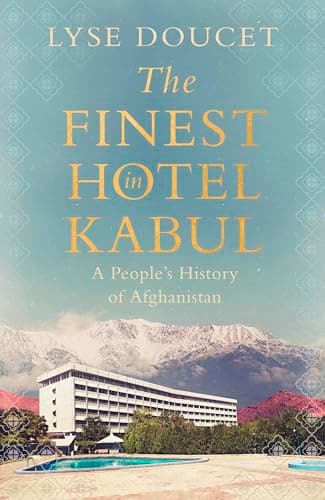
The Finest Hotel in Kabul
by Lyse Doucet
"I came for the hotel and stayed for the people. The Finest Hotel in Kabul made a complicated country feel human, and I finished it understanding Afghanistan far better than before."
Synopsis
The Finest Hotel in Kabul follows the Intercontinental Hotel, which opened in the 1960s on a hilltop overlooking Afghanistan's capital. From the start it was meant to be a symbol of a modernizing country, a place where visitors from around the world could stay in comfort above the city.
The book's characters are the people connected to the hotel over the decades. They include the staff who kept it running, the guests who passed through, and the journalists and officials who watched events unfold from its rooms. Lyse Doucet, a longtime BBC correspondent who has reported on Afghanistan for years, draws on her own experience and on the voices of those who knew the place firsthand.
The conflict at the heart of the story is the sweeping change that has overtaken Afghanistan, from periods of hope to long stretches of war and political upheaval. The hotel stands through it all, sometimes a refuge, sometimes a target, and always a witness.
The stakes are both personal and national. For the people inside, survival and dignity are at issue. For the country, the question is what kind of future is possible. Doucet uses the hotel as a lens, offering a human-scale history of a place too often reduced to headlines.
Our Take
Lyse Doucet is a veteran BBC journalist, and that experience shapes this book in the best way. Rather than approaching Afghanistan through a single political lens, she tells the story of the Intercontinental Hotel in Kabul, a place that has stood on a hill above the city through decades of upheaval. The hotel becomes a way of seeing the country, with real people moving through it: staff, guests, and observers whose lives intersected with a nation in turmoil.
What works is the human scale. Big historical events can feel distant, but a building with employees, regulars, and rooms makes them concrete. Doucet's reporting background gives the book a patient, observant tone, and her long familiarity with Afghanistan adds depth without turning the pages into a lecture.
If you liked Wild Swans by Jung Chang for its way of tracing a country's history through personal stories, this is a natural next read. Readers who enjoyed The Bookseller of Kabul by Asne Seierstad will recognize the focus on everyday people in Kabul. And if The Looming Tower by Lawrence Wright appealed for its narrative approach to complicated recent history, this offers a gentler but equally informed entry point. It is a thoughtful pick for Women Author Wednesday, especially if you want nonfiction that reads like a story.