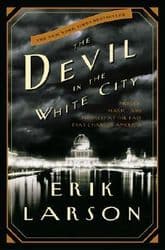
The Devil in the White City
by Erik Larson
True Crime
Narrative History
447 Pages
"I picked up The Devil in the White City expecting a crime story and ended up fascinated by the fair itself. I kept flipping between the building drama and the creepy parts, and I couldn't put it down."
Synopsis
The Devil in the White City is set in Chicago in the early 1890s, a booming, smoky city determined to prove itself by hosting the 1893 World's Columbian Exposition. The city has beaten out rivals for the honor, and now it has to build a dazzling fairground from marsh and mud on a punishing deadline.
The book follows two men whose paths run side by side. Daniel Burnham is the architect charged with turning the vision into reality, gathering the greatest designers of the age and wrestling with setbacks, egos, and the clock. Meanwhile, a young doctor named H. H. Holmes arrives in the city. He is charming and well dressed, and he sets about building a hotel near the fairgrounds that has a very different purpose.
Larson tells both stories as a true account, drawing on historical records to move between the ambition of the fair and the darkness growing in its shadow. The stakes run on two tracks: whether Chicago can pull off a wonder that will shape the country, and what happens to the visitors and workers drawn into the city while a predator waits among them.
Our Take
Erik Larson has a gift for making history read like a novel, and this is probably the book that made that gift famous. The structure is the smart part. Instead of treating the World's Fair as backdrop, he gives it equal weight with the crime story, so the book becomes a portrait of a city and an era as much as a true crime tale. The contrast between civic grandeur and quiet menace is what gives it its pull.
If you come for the killer, know that the architecture and planning chapters take real space. That patience pays off, since it makes the fair feel like a living, breathing place, and it sharpens the unease whenever the story turns to Holmes. Larson sticks to documented history, and his endnotes and sourcing are part of the appeal for readers who like to know where the details come from.
It is a great fit for readers who like their nonfiction immersive rather than clinical. Fans of Larson's own Dead Wake and Isaac's Storm will recognize his method of braiding a big historical event with individual human stories. Readers who enjoyed The Poisoner's Handbook by Deborah Blum, which also pairs crime with the science and spirit of its time, will find the same satisfying blend here. It is a long read but a very rewarding one, and a strong pick for anyone curious about how true crime and history can share a single page.