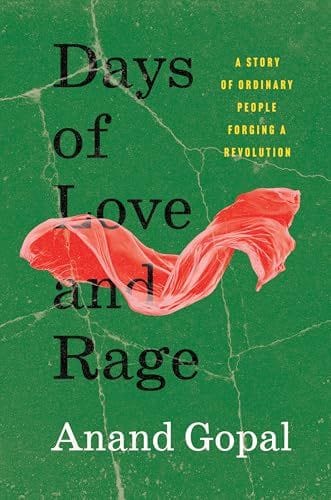
Days of Love and Rage
by Anand Gopal
History
Non-Fiction
592 Pages
"Days of Love and Rage does what only the best journalism can — it makes you understand a conflict not through statistics or politics, but through people you come to love."
Synopsis
In 2011, in the northern Syrian city of Manbij, a small group of men and women helped ignite a movement that toppled a brutal dictatorship. For the next eighteen months, those citizens carried out one of the most remarkable experiments in grassroots democracy in modern history — and then watched it come apart. Days of Love and Rage tells that story through six Syrians at the center of it all: a pair of best friends pulled apart by political polarization, a mother who challenges the structures of male dominance around her, a worker who risks everything on the dream of equality. Pulitzer and National Book Award finalist Anand Gopal embeds himself in the life of a single city to render the revolution from the inside — the exhilaration of early solidarity, the trauma of betrayal, and the crushing weight of authoritarianism reasserting itself. The result transcends the particulars of the Syrian conflict to illuminate the universal dangers that inequality poses to democracy, and the enduring human need for dignity and hope.
Our Take
Anand Gopal's previous book, No Good Men Among the Living, changed how many readers understood the war in Afghanistan by doing something deceptively simple: it told the story through the people actually living it. Days of Love and Rage applies the same method to Syria, with the same devastating results. By anchoring an enormous, complex conflict to six specific human beings in one specific city, Gopal makes the abstract concrete and the political personal in ways that statistics and analysis never can. The eighteen months of democratic self-governance in Manbij that Gopal documents are little known outside of specialist circles, and that obscurity is itself part of the book's argument — about whose stories get told, whose sacrifices get counted, and how quickly the world moves on. The writing has the propulsion and intimacy of great literary nonfiction, inviting comparisons to Philip Gourevitch's We Wish to Inform You That Tomorrow We Will Be Killed With Our Families and Katherine Boo's Behind the Beautiful Forevers. This is essential reading for anyone trying to understand authoritarianism, democracy's fragility, or simply what it costs ordinary people to fight for a better world. One of the most important books of the year.