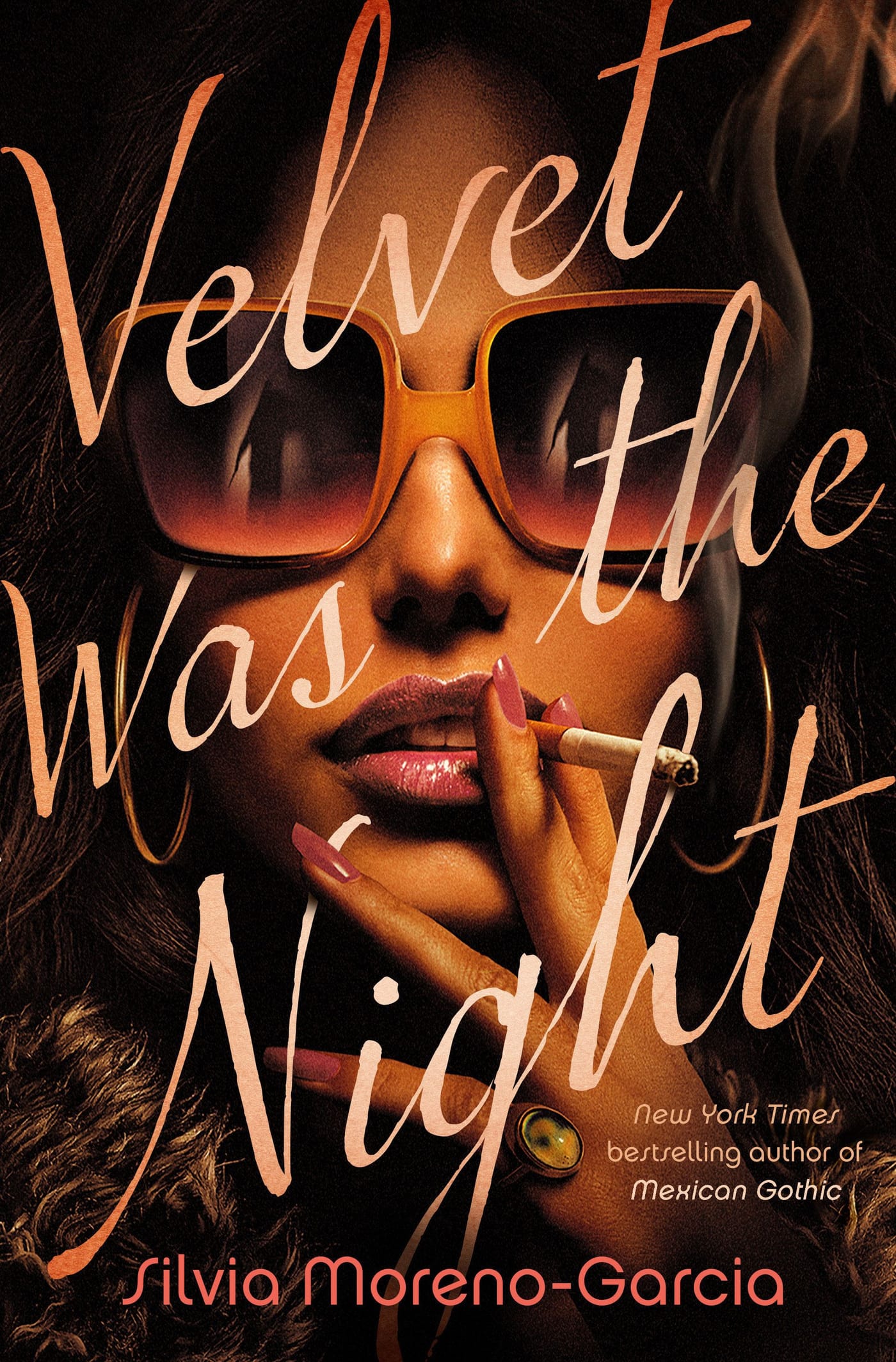
Velvet Was the Night
by Silvia Moreno-Garcia
Historical Fiction
Crime
Suspense
289 Pages
"I've read a lot of noir and Velvet Was the Night is unlike any of it. The setting is electric, the characters are genuinely sad and fascinating, and the whole thing has this atmosphere you can't shake."
Synopsis
Mexico City, 1971. The streets are restless with student activists, government enforcers, and the ever-present threat of the Dirty War—a period when the Mexican government violently suppressed political dissent through a shadowy paramilitary group known as the Hawks. Into this charged atmosphere steps Maite, a thirty-year-old secretary who moves through life half-present, sustained by romance comics and daydreams of a more glamorous existence. When her neighbor Leonora—a beautiful art student with ties to radical circles—vanishes without explanation, Maite finds herself drawn into a search she never intended to begin. Moving in parallel is Elvis, a soft-hearted enforcer who loves rock 'n' roll and hates his job, assigned by his handlers to locate the same missing woman. The two investigate Leonora's disappearance from opposite ends—Maite driven by curiosity and a strange hunger for meaning, Elvis by orders he's beginning to question—navigating hitmen, government agents, and Russian spies as the city tightens around them. Velvet Was the Night is grounded in real historical events, and Moreno-Garcia brings the atmosphere of 1970s Mexico City to life with the same precise, immersive instinct she brought to Mexican Gothic—this time trading gothic dread for something smokier, slower, and equally hard to put down.
Our Take
Oprah Daily noted that Moreno-Garcia "gleefully pries hard-boiled noir from the cold, white hands of Chandler and Hammett" with this novel, and the description is apt—but it undersells what she actually does here. Velvet Was the Night isn't just noir in a new location. It's a reimagining of what the genre can hold: political history, loneliness, class anxiety, and two deeply unglamorous protagonists who have no business being in the middle of any of this. Maite and Elvis are the novel's real achievement. Neither is conventionally appealing—she's prickly and self-deluding, he's a criminal who wishes he weren't—and both are quietly, persistently sad in ways that feel completely real. NPR called them "unique, flawed, and sad in a way that burrows into your heart," and the slow convergence of their parallel storylines is handled with genuine craft. The novel was named a best book of the year by the New York Times Book Review, NPR, the Washington Post, and the Boston Globe, and was a finalist for the Los Angeles Times Book Prize. That's a wide range of endorsements for a noir, and it reflects how much this book operates on. Readers who loved Mexican Gothic by Silvia Moreno-Garcia should come in knowing this is a different beast—quieter, more character-driven, less horror. Fans of The Long Goodbye by Raymond Chandler will recognize the DNA while appreciating how far Moreno-Garcia pushes the form. And anyone drawn to In the Woods by Tana French for its combination of atmosphere and psychological depth will find a lot to love here.