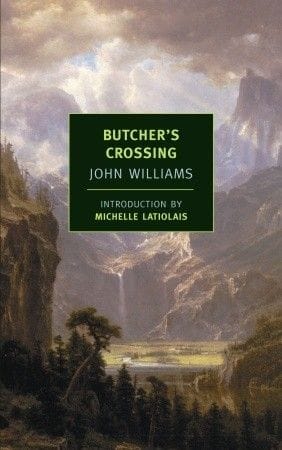
Butcher's Crossing
by John Williams
Literary Fiction
Historical
Western
274 Pages
"Butcher's Crossing gutted me. Williams writes the West without any of the romance — just cold, brutal clarity. One of the most unsettling books I've ever read."
Synopsis
It is the 1870s, and Will Andrews — fired by Emerson's call to seek an original relation to nature — drops out of Harvard and heads west. He arrives in Butcher's Crossing, a small Kansas town populated by restless men chasing fortune and burning through it just as fast. There, Andrews falls in with a hunter who speaks of an untouched valley deep in the Colorado Rockies, sheltering vast herds of buffalo that have never seen a rifle. Drawn by the promise of something wild and unmediated, Andrews funds an expedition into the mountains alongside the hunter and two other men. The journey out is punishing, but what they find at the end of it exceeds all expectation — a place of almost paradisal abundance. And then the killing begins. Consumed by an escalating, almost compulsive slaughter, the men lose track of time entirely. When winter descends and traps them in the valley, the journey back — physical and psychological — becomes something none of them could have anticipated. Butcher's Crossing is a fiercely intelligent dismantling of frontier myth and the American dream of conquest.
Our Take
John Williams is best known for Stoner, his quiet masterpiece of academic resignation, but Butcher's Crossing may be his most unsettling work. Where Stoner turns inward, this novel turns outward — into the landscape, into violence, into the gap between what idealism promises and what the world actually delivers. Andrews arrives in the West as a disciple of Emerson, convinced that proximity to raw nature will clarify something essential about existence. What he finds instead is that nature is indifferent, men are capable of extraordinary brutality, and the myths that draw people westward have very little to do with what's waiting for them there. Williams writes with the same controlled, almost austere precision that distinguishes all his work, and the novel's pacing — deliberately slow in places, harrowing in others — mirrors the psychological compression of its characters. Readers who appreciate Blood Meridian by Cormac McCarthy or The Revenant by Michael Punke will recognize the territory: the West as a place that strips men down rather than building them up. This is essential reading for anyone who wants to understand how American literary fiction engages with the mythology of the frontier — and why that mythology has always been more complicated than it appears.