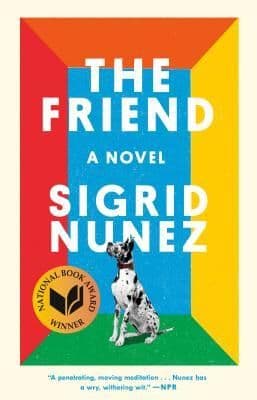
The Friend
by Sigrid Nunez
Literary Fiction
Contemporary
Memoir-esque
224 Pages
"Nunez transformed what could have been maudlin into something profound. The Friend made me laugh, cry, and think deeply about the nature of grief and companionship."
Synopsis
When an unnamed writer loses her lifelong best friend and mentor to suicide, she inherits an unexpected burden: his massive Great Dane, Apollo. Grieving and living in a cramped Manhattan apartment where dogs are strictly prohibited, she faces an impossible choice. The dog, traumatized by his master's inexplicable disappearance, suffers his own mute grief, refusing to eat and waiting endlessly by the door. As friends and family worry that her attachment to the dog signals a dangerous unraveling, the writer refuses to give Apollo up. Isolated from the world and increasingly obsessed with understanding the grieving animal's heart and mind, she finds herself teetering on the edge of collapse. Yet within this unlikely companionship—between woman and beast, both struggling with incomprehensible loss—lie surprising rewards and the possibility of healing. The Friend is an elegant meditation on grief, the writing life, human-animal bonds, and the unexpected forms that love and salvation can take.
Our Take
Sigrid Nunez's National Book Award-winning novel defies easy categorization, blending memoir, essay, and fiction into something uniquely powerful. At just 224 pages, The Friend packs extraordinary emotional depth into its spare, crystalline prose. Nunez writes with a dry, direct tone that perfectly captures the exhaustion of mourning while threading the narrative with darkly humorous observations and profound literary reflections. The novel explores not just grief but the writing life itself, filled with quotations and meditations on authors from J.M. Coetzee to Rainer Maria Rilke. What could have been sentimental becomes instead a penetrating examination of loss, loneliness, and the salvific power of unexpected companionship. The relationship between narrator and dog feels earned rather than manipulative, and Nunez never pretends that love can banish loss—only that it can coexist with it. If you appreciated the contemplative style of Dept. of Speculation by Jenny Offill or the unflinching grief work in H Is for Hawk by Helen Macdonald, The Friend offers similar rewards. This is essential reading for writers, dog lovers, and anyone who has grappled with the impossible task of continuing after devastating loss.