Fiction

Recent Content

Say You'll Remember Me

Say You'll Remember Me

Say You'll Remember Me by Abby Jimenez: A veterinarian meets his match in a woman who can't commit—but their connection refuses to fade.

Read more
Hemlock & Silver

Hemlock & Silver

Hemlock & Silver by T. Kingfisher: A dark Snow White retelling where a poison-drinking healer must save a dying princess from magical threats.

Read more
Blacktop Wasteland

Blacktop Wasteland

Blacktop Wasteland by S.A. Cosby: A reformed getaway driver is pulled back into crime for one last heist that goes catastrophically wrong.

Read more
Checkout 19

Checkout 19

Checkout 19 by Claire-Louise Bennett: A radical novel about a young woman discovering her creative genius through books, people, and imagination.

Read more
Say Nothing

Say Nothing

Say Nothing by Patrick Radden Keefe: The mesmerizing true story of a mother's murder and Northern Ireland's Troubles and their aftermath.

Read more
See All Content
logo
  • Fiction
  • Mystery & Thriller
  • Fantasy & Sci-Fi
  • Non-Fiction
  • Other Genres
  • About Us
  • Fiction
  • Mystery & Thriller
  • Fantasy & Sci-Fi
  • Non-Fiction
  • Other Genres
  • About Us
  • ​
    ​
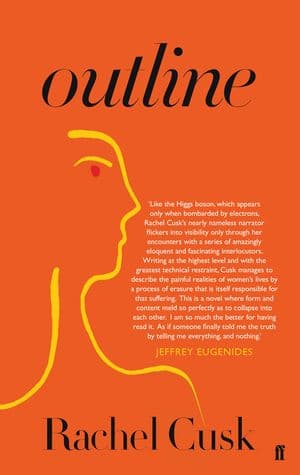
Outline book cover

Outline

by Rachel Cusk

Literary Fiction
Experimental
Contemporary
249 Pages

"Mesmerizing and unlike anything else—Cusk creates a self-portrait through absence, revealing everything by saying almost nothing."

Synopsis

A woman writer travels to Athens at the height of summer to teach a writing course. Though her own circumstances remain deliberately indistinct, she becomes the audience to a chain of narratives as the people she encounters tell her one after another the stories of their lives. Beginning with the neighboring passenger on her flight and his tales of fast boats and failed marriages, the storytellers talk of their loves and ambitions and pains, their anxieties, their perceptions and daily routines. In the stifling heat and noise of the city, this sequence of voices begins to weave a complex human tapestry. The more they talk, the more elliptical their listener becomes, as she shapes and directs their accounts with subtle questions and observations until certain themes begin to emerge: the experience of loss, the nature of family life, the difficulty of intimacy, and the mystery of creativity itself. Yet through this act of listening and erasure, the narrator paradoxically becomes more visible, her own story revealed in negative space through what she chooses to elicit from others. Outline is a novel about writing and talking, about self-effacement and self-expression, about the desire to create and the human art of self-portraiture in which that desire finds its most universal form.

Our Take

Outline is a radical experiment in form that shouldn't work but absolutely does—a novel where the protagonist barely speaks yet becomes utterly compelling through her silence. Rachel Cusk has created something genuinely innovative: a self-portrait in negative space, where the narrator's identity emerges through her careful curation of others' confessions. What could feel gimmicky instead becomes hypnotic. The conversations are so precisely observed, so psychologically astute, that you find yourself leaning in, searching for what the narrator reveals through her questions and occasional interjections. Cusk's prose is crystalline and controlled, each sentence doing multiple kinds of work simultaneously. The novel explores profound questions about identity, authorship, and whether we ever truly know ourselves or simply collect others' versions of us. Some readers find the lack of traditional plot frustrating, but that's precisely the point—this is fiction that mirrors how we actually experience life, through fragmented conversations and partial revelations rather than neat narrative arcs. The first in Cusk's acclaimed trilogy (followed by Transit and Kudos), it's essential reading for anyone interested in what contemporary literature can do. Fans of 10:04 by Ben Lerner or Swimming Studies by Leanne Shapton will appreciate Cusk's formally inventive approach. Outline proves that sometimes the most revealing self-portrait is the one where the artist steps out of frame.
Related Content

Terms and ConditionsDo Not Sell or Share My Personal InformationPrivacy PolicyPrivacy NoticeAccessibility NoticeUnsubscribe
Copyright © 2026 Plot Digest