Classics

Recent Content

Say You'll Remember Me

Say You'll Remember Me

Say You'll Remember Me by Abby Jimenez: A veterinarian meets his match in a woman who can't commit—but their connection refuses to fade.

Read more
Hemlock & Silver

Hemlock & Silver

Hemlock & Silver by T. Kingfisher: A dark Snow White retelling where a poison-drinking healer must save a dying princess from magical threats.

Read more
Blacktop Wasteland

Blacktop Wasteland

Blacktop Wasteland by S.A. Cosby: A reformed getaway driver is pulled back into crime for one last heist that goes catastrophically wrong.

Read more
Checkout 19

Checkout 19

Checkout 19 by Claire-Louise Bennett: A radical novel about a young woman discovering her creative genius through books, people, and imagination.

Read more
Say Nothing

Say Nothing

Say Nothing by Patrick Radden Keefe: The mesmerizing true story of a mother's murder and Northern Ireland's Troubles and their aftermath.

Read more
See All Content
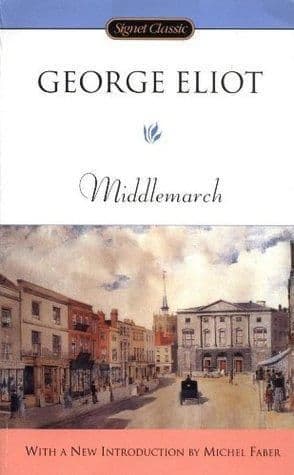
Middlemarch book cover

Middlemarch

by George Eliot

Realism
Social Commentary
Psychological
912 Pages

"Middlemarch contains more insight into human nature than most psychology textbooks. Every time I reread it, I'm astounded by how Eliot can be simultaneously so clear-eyed about human failings and so compassionate toward her flawed characters."

Synopsis

Middlemarch explores the interconnected lives of several characters in the provincial English town of Middlemarch during the period of social and political reform around 1830. At the novel's center is Dorothea Brooke, an idealistic young woman who marries the elderly scholar Edward Casaubon, hoping to assist in his intellectual pursuits. She soon discovers their marriage to be an emotional desert, as Casaubon works obsessively on his doomed "Key to All Mythologies." Meanwhile, the talented young doctor Tertius Lydgate arrives in Middlemarch with ambitious plans to advance medical science, but his marriage to the beautiful but materialistic Rosamond Vincy gradually undermines his professional goals. Other significant plotlines involve Fred Vincy, Rosamond's brother, whose gambling debts threaten his relationship with the plain but worthy Mary Garth; the religious banker Nicholas Bulstrode, whose past misdeeds eventually surface; and Will Ladislaw, Casaubon's young cousin who forms a connection with Dorothea. As these stories unfold against the backdrop of the Reform Bill's passage, characters must navigate both personal desires and social expectations, with their choices and compromises revealing the complex interplay between individual aspirations and community constraints.

Our Take

Often described as "the greatest English novel," Middlemarch represents the pinnacle of psychological realism and social observation in fiction. George Eliot's supreme achievement lies in her creation of a microcosm—the provincial town of Middlemarch—that becomes a lens for examining the entire spectrum of human experience, from the most intimate psychological struggles to broad social and political movements. What distinguishes Eliot's approach is her remarkable combination of scientific precision in observing human behavior with profound moral sympathy for her characters' limitations and failures. The narrator's famous "web" metaphor for society perfectly captures Eliot's method: showing how individual lives both shape and are shaped by the complex network of relationships, institutions, and historical forces surrounding them. In Dorothea Brooke, Eliot created one of literature's most compelling heroines—a woman whose spiritual and intellectual ardor cannot find adequate expression within the constraints of Victorian gender roles, yet whose growth comes through engagement with reality rather than retreat into romantic fantasy. Similarly, Lydgate's scientific idealism collides with both provincial resistance to change and his own character flaws, resulting in a nuanced examination of how even noble ambitions can be compromised. Beyond its psychological depth, Middlemarch offers a profound meditation on marriage, vocation, moral growth, and the often-invisible impacts of ordinary lives—culminating in one of literature's most moving final passages about "the growing good of the world" being dependent upon unhistoric acts of kindness. Nearly 150 years after its publication, Eliot's masterpiece continues to set the standard for depicting the full complexity of human experience within a social context.
Related Content

Terms and ConditionsDo Not Sell or Share My Personal InformationPrivacy PolicyPrivacy NoticeAccessibility NoticeUnsubscribe
Copyright © 2026 Plot Digest